Community: Unity in Common

To be “common” is to be of frequent occurrence; the normative, the usual, simply normal. Two or more people can hold a thing “in common,” making it general commodity. We’ve heard of “common knowledge,” describing something that the majority should generally know. We hear a lot about so-called “common sense,” which isn’t very common and doesn’t make much sense anymore. A group of people could have a “common belief;” a shared belief system that gives identity to and is very important for the group of individuals that hold it. The idea of “common” also expands into mathematics, speech, grammar, anatomy, and law, etc. but the meaning doesn’t drift far from the original intent.

“Unity” is a state of being one; oneness. To speak of “unity” infers combined parts; two or more parts have come (or were put) together to form one whole. Often the ideology of “unity” (oneness) takes on the notion of sameness; that there is no diversity in the sum whole of the parts. Two or more people could come to an agreement and, therefore, be said to be in “unity.” Again, the idea of “unity” (or not) has been adapted to mathematics and the arts, etc.

A “Community” is a social group of two or more that may share a common language and/or culture and/or rules and/or beliefs and/or heritage and/or locale having a unity in a common life. Sometimes a “community” purposely lives thusly to distinguish itself from others. A place where two or more things live could be a “community.” The understanding of “community” pervades law and the sciences, etc.

God is a “community” – a trinity – within God’s-self. Humanity derives from the “God-community.” From the whole came the parts (i.e., creation), and the parts are called to become one in the whole (salvation). In this in-between place – the now, but not yet – we are “united” in a “common” calling: Humanity as a whole, and not distinct from its parts, is called to live in “community.” There is diversity, by definition, because of its parts – differing races, cultures, rules, heritage, language, and etc. – but diversity is not contrary to oneness, but only sameness. It is the power of God’s Spirit in the Person of God’s grace – Jesus Christ – that unites this diversity in “community.”

“Community,” then, in one sense is “common” – we hold the Source of community and the humanness of community in common. Ironically, though, the “common sense” required for this “common knowledge” has been lost on humanity, generally. Therefore, on the other hand, life together as “community” is not a frequent occurrence. Likewise, “Community” is a shared wholeness of its combined parts. “Unity” is an agreement between differing parts to being part of the whole “community.” Then again, “community” is not one part(s) forcing its own race, culture, rules, heritage, language, and etc. onto the other part(s) and calling it “unity.” God’s grace “unites” the differing “common” parts into one whole “community” sharing the life of God’s Common-Unity. Like putting a whole puzzle back together, all the individual parts (each with their peculiar shapes) must be utilized in order to return to the puzzle’s whole picture.
The Body of Christ

In one sense, the “body of Christ” speaks of the actual physical element that was offered as a sacrifice to fulfill the Old Testament’s requirements; Christ’s historical body, killed on His cross, through which we have been made acceptable to a holy God (Heb. 10:10). Healing from the distorted image of God – the fallen-ness of humanity – comes when we have died with Christ through the (actual physical, historical) “body of Christ” and are united with the (alive, now!) resurrected Christ so as to be the real image of God to a hurting world (Rom. 7:4).

In another sense, the “body of Christ” is a sign and symbol of the actual and physical element; a sacrament of the church, expressed in the bread of The Lord’s Table – The Eucharist (The Thanksgiving) – otherwise known as, Communion. Paul refers to this as a “sharing together” in the loaf of bread we break – the “body of Christ” (1Cor. 10:16) – broken for and by us.

And yet, there is another sense to the “body of Christ,” not so much a third sense as it is a syncretism of the first two. The Church, not a building but a people, called and equipped from across the earth to be the expression of Christ on earth, is the actual physical “Body of Christ” (Rom. 12:5; 1Cor. 12:12, 27; Eph. 3:6; 4:12; 5:23; Col. 1:24; 3:15). As expressed at the Communion Table, the Church is visible and invisible, spanning all human history, inclusive of all cultures and ethnicities, throughout all the earth. This is a declarative act, proclaiming the death of Christ until He comes again; re-membering (bringing together again) broken humanity with His broken body. “The ‘body of Christ’ broken for you” is a calling of Christ to the Cross of Christ to be the “Body of Christ” in the earth.

The Body of Christ; gathered around Christ and gifted by the Spirit of God in the world. The church doesn’t have a mission the church IS the mission of God in humanity. The mission of God in God’s chosen people is a story of people living in and out of the community of the Spirit. The Body of Christ is to be a sign and symbol, and yet an actual physical, historical reality, of God’s love in Jesus Christ. Though we haven’t fully realized the truth of the sentiment yet, The Body of Christ is the reality that we are to be one, holy, apostolic, universal expression of the One God in three persons; we are the beauty of invisible unity (God) clearly visible, in the world but other than the world system, a consistent constancy, always, everywhere, and at all times.

Faith Seeking Understanding

I find myself, once again, at Duke Divinity School (I took 2012 off!). My sixth year here is not as before. The previous five years were a completion of the Pastors’ Course of Study School; however, this year is a continuation of my personal Vision to receive everything that the United Methodist Church has for me. My classes this year concern only Methodism, what we jokingly consider “UM P.H.D.”: Advanced United Methodist Polity, History, and Doctrine. I will report on these classes as the weeks move along. For now though, I am reminded of what I posted two years ago as I was finishing the five-year Course of Study:

For some, simple faith is enough. I do not mean this in the sense of “works vs. faith” and neither do I speak in an absolute sense of salvation and the role of faith. I refer to the fact that some are satisfied with simply having faith, while others are interested in faith that seeks understanding (i.e., theology). That is how I view the five years of my life that I have spent here at Duke Divinity (not to mention another six years at NTS). Some argue that education “ruins the minister,” while others think it is mandatory for ministry. Many are afraid of education and many others put far too much faith in it. I think that it obviously depends on the state of mind of the one seeking the understanding, if one so wishes, whether or not it is a good or bad thing to seek understanding.

I think it is important to know and understand why and how we do/believe/think the things and the ways we do/believe/think. Do we seek academia to give the answers to these questions? Certainly many do. The consequence of this is that these persons do not contribute to the ongoing conversation, but only serve to regurgitate the thinking of some professor or former (or present) thinker. There are many professors and/or thinkers of the ages with which I agree, but that is not why I am here. I am not here to get answers, but material. I want to hear the arguments presented throughout the ages so that I may enter the conversation and (God willing) contribute. Do I come away from these conversations with something? Certainly! Not simply because someone said it, but because of taking part in the conversation makes me think through the why and how we do/believe/think as we do (or do not).

Some enter the academic setting with their theology already concretized. Many of these experience a crack in their concrete, and some have it strengthened further. Others enter without a theological basis at all – empty shells waiting to be filled – and these are the most impressionable, and (quite honestly) the most naive. These are those who feel a certain professor or thinker is the proverbial “be-all-end-all,” as though such a one is the only one having the conversation. Yet, another interesting thing are those who sense no change in what they think, theologically or otherwise, even after years spent overhearing the conversations of the ages. These, to me, are most alarming! No one person (or group) has all the answers and, more often than not, a balance or combination of persons (or groups) gives a fuller picture of the whole. If you ever quit learning, you quit thinking.

I cannot fail to mention an almost universal variable in all of this, namely, human frailty. It seems that most folks deem it detrimental to have all the answers, while others speak as though there are no answers to be had and thus only speak in philosophical circles. Many seek academics in the hopes of knowing something that “common folks” do not, as though their actual self-worth is in question. Others are truly seeking to understand what they know and this affects their spheres of influence (the way we think affects the way we live – good or bad).

Personally, I wish only for us to think. Period! And I have spent 11 12 years, now, (academically) learning and processing ways to help us to do just that. I wish to invite you into the conversation. In my opinion, the faith we claim demands understanding (i.e., theology). Faith seeking understanding… Dare to know.

Counterfeit Faith

Faith and religion are not synonymous. Nor is faith an object in the subject of religion. The notion of “the plurality of faith” is unintelligible as well. This is something the Church must understand if it is to be, once again, an agent of change in humanity. As long as Christians insist on arguing the validity of the “Christian Religion” they will always be entangled in the distraction of arguing the irony of a pointless point-of-view. Likewise, as long we are willing to accept the fallacy that Christianity is a “superior religion” we will always be hopelessly ineffective and helplessly self-contradicting.

There is no religion in the world that is any better than any other (nor can there be).  Religion is a human attempt to reach God (at best) and is a human attempt to counterfeit God’s grace (at its worst).  Religion (of any sort) is expressed by a varying array of belief systems, built by human beings, where the powers-that-be set moral and ethical norms, rules, liturgies, rituals, and whatever else it deems necessary to enable its adherents to do the best they can to be the best they can (whatever that means). These belief systems, by their very nature, are exclusive (“you must be like us”). They are suspicious of and threatened by any and all other belief systems. Such belief systems enforce their norms and increase their influence by the use of fear and intimidation.

Faith is altogether different. Faith is the single means by which God has moved within humanity. It is expressed by a single action – the faith OF Christ – where the very substance which carried Him to His cross is made available to any and all who will receive it. Faith is empowered by the dynamite (“dynamo” in the Greek) of God – It comes from the grace of God offered only by God. It causes a fundamental transformation in the individual (the person), which equips the corporate (the Church) to be an agent of change in humanity. Faith is a way of life, equipped solely by the living life supply of the Resurrected Christ.

Faith is the fount that all belief systems attempt to imitate, but inevitably counterfeit. While there are many forms of religion (including much of Christianity), there is only one faith (found only in Jesus Christ). Faith does not attempt to convert (which is a key principle of religion) but simply loves. And, perhaps, the most striking counterfeit of all is where religion will sacrifice the one for the sake of itself, but Faith will risk everything, including itself, for the sake of one.

The Pillars of Faith and Religion

It was not religion that empowered Jesus to go to the cross. Neither was it religion that equipped Him to hang, nailed with the sins of humanity. Nor was it religion that raised Him from the dead. It certainly is not religion in which He presently lives in resurrection power. And, likewise, it is not religion that equips humanity with that resurrection power. It was, and still is, the Faith of Christ – a personal relationship that is concretized in who God says God is. The Faith of Christ carried Christ to the killing Cross, then, raised Christ from the endless grave and, now, empowers Christ to forever live in the reality of the resurrection Life. And that resurrection life is made available to all humanity through the Faith of Christ.

Religion is humanity’s counterfeit attempt to duplicate Faith – that, which, God has determined to be the only means of acceptance by God (Hab. 2:4; Rom. 1:17; Gal. 3:11; Heb. 10:38). All religion has the same origin and, contrary to popular belief, the same outcome. Humanity was made with an inert desire to walk with God. Having fallen out of relationship with God, humanity’s desire now results in religious intentions, which are driven by a religious nature (Romans 1). This being true, then, all religion is on equal footing – slippery as it is – in an attempt to reach God. Regardless of its name, its ethos, or its god (or its lack thereof), no religion is better than any other, including much of so-called “Christianity,” and all necessarily fall short of God’s acceptance. Religion will never reach God, nor can it, by definition of “God.”

The Faith, which God had determined would be the only acceptable way to access Him, seemed impossible with the degenerate state in which humanity found itself. With one nation did God establish a faith-based system, which proved only to be fodder for the religious nature of humanity, and Israel turned this, too, into simple religion (a temple cult). Let it be a lesson to humanity that faith cannot be an outward indoctrination, but that it necessarily must be an inward transformation.

Such an inward transformation is only probable in the resurrection life of Christ; made possible by the Faith of Christ – that very same faith of His which carried Him to the cross. Faith in Christ is nice, but the Faith of Christ is powerful. Faith in Christ is based on humanity and its frailty, while the Faith of Christ is based on divinity and its reality. Faith in Christ is too easily transferred into religion, where the Faith of Christ is the only means to transform from it.

The Faith of Christ was the agent of change, those many years ago, when Jesus came to free humanity from its religion (and its results). And the Faith of Christ is still the agent of change, today, when the church decides to be free from its human religion (and its results).

Invitational Incarnation

After many conversations and debates (i.e., arguments) on the topic, I beg the question: “Based on what biblical principle does one ‘invite Jesus into [ones] heart’?” Admittedly, I understand the ideology behind the sentiment of this invitation, but the logical conclusions are inescapable; the theological ramifications, unacceptable. The question begged is rhetorical – I do not expect an answer (because there is not a scriptural one to be had). But the answers (almost always) offered prove only the point of my rhetoric.

Only because I like to argue I ask, “How does one go about ‘inviting Jesus into ones heart’?” The reply: “The Sinners Prayer.” I then beg the question: “Where, exactly, does one find the ‘Sinners Prayer’ in the Scriptures?” Again, the question begged is rhetorical to prove a point. For many the idea of “inviting Jesus into ones heart” is a manipulative attempt of control. The sentiment is that of prevention, rather than permission; bondage rather than freedom. It is more about a religion than a faith; conformation rather than transformation. Ironically, many of these are quick to judge the outward actions of others, but are completely ignorant of their own inner decay. Or (worse) they are keenly aware of their own inner impulses and simply project that wickedness onto others; assuming that everyone is as sensuous as they are.

For others it’s more innocent. They mean well. They say, “Jesus (or God) is my Copilot.” They think that Jesus is at their disposal, offering His help if needs be. Or they think that Jesus is locked away safely in their hearts and now they can take it from here – “Now I’m a good person” or (my favorite) “…a good Christian.” Some even “invite Jesus into their hearts” and believe Him to be like a genie in a bottle – three wishes if they ever need. But it’s Jesus who offers you and me the invitation to live with Him! We do not “live for Christ,” He offers a whole new life for living (John 3:3). After Jesus says “take up your cross and follow me,” He clearly explains that you must lose the old you so as to receive the resurrection of the new you (Matt. 16:24-25). “This is what we know: the person that we used to be was crucified with Him in order to get rid of the corpse that had been controlled by sin” (Rom. 6:6 CEB). Jesus doesn’t simply live in our hearts; He is now our life supply, our life for living. The lives we now live are by the faithfulness of Christ, not our own (Gal. 2:20). He is not the founder of a religion; an example of how to live a moral/ethical life of your own. It is not about ignoring or suppressing the desires and passions of the fallen nature, or counter-weighing the “bad” with “good.” It is that we have killed the desires and passions on the killing Cross of Christ (Gal. 5:24).

The Scriptures are clear. Those who attempt to (somehow) follow Jesus in the old life are “unspiritual” Christians (“carnal” – KJV). And those who lose their old lives – picking up their crosses and following Jesus to Golgotha; impaling the flesh on the cruel cross; being born again, from above – are “spiritual” Christians (1Cor. 3:1-3). The biblical principle is transparent. The grace of God (alone) is calling everyone to believe the Good News found in Jesus Christ. This rescuing is God’s gift, not something you possessed. We are God’s accomplishment, created in and by the faithfulness of Christ, in which we are called and equipped to live (Eph. 2:8-10). The invitation is incarnational – God, taking on flesh, inviting you to be a part of Him.

What is Truth?

The question asked by Pontius Pilate (John 18:38) in the first century rings through the ages and into the twenty-first century. The idea of “truth,” and its interpretation, in the ancient Greco-Roman world was left to the philosophers. Before Pilate stood the Personification of Truth – Truth Himself – and Pilate didn’t recognize it (Him). Often we do not recognize truth when we see or hear it. There is an ignorance clause concerning truth, if one cannot recognize it. But ignorance is not bliss when one can recognize it, but chooses not to do so. More often than not we recognize truth, and do not like it. So we invent our own version or interpretation of truth, and like idiots we then live out of the fantasy that we’ve created.

Logically speaking, there must be Truth; otherwise, things would be neither true nor untrue. Without Truth there is nothing by which to measure validity; nothing by which to measure if something is true or untrue. According to the Laws of Logic (a tool of Truth to measure validity) two competing “truths” cannot, at the same time, both be “true.” For example: The competing statements, “truth is relative” and “truth is not relative” cannot both be true. Either, one is true and the other untrue, but both cannot at the same time be true. Furthermore, the statement “truth is relative,” by its own admission, is not true. The truth of the statement has been called into questioned by the statement itself. Likewise, there are some (possibly, like Pilate) who deny that there is truth. To deny that there is truth negates the notion that there is not truth. It is not (logically) possible to believe there is no truth. One is making a Truth Statement when they say that “there is no truth” and, therefore, denying the “truth” of not believing in “truth.”

Theologically speaking, Semitic (Jewish) thought concerning “truth” stressed reliability and concreteness – truth is something that never changes; something by which everything can be measured against. In Hellenistic (Greek) thought, “truth” was understood as reality, which often would not align well with the way things might appear – the immaterial is more trustworthy and true than the material. The New Testament writers often blended these two thoughts. They operated out of the notion of a Truth always seated in Jesus Christ (Jn. 14:6; Gal. 2:5, 14; Eph. 1:13; 2:21; Col. 1:5; 1Tim. 2:4). They expected that Jesus followers would live a life out of this Truth (1Cor. 5:8; 13:6; Eph. 4:15, 24). God’s Self-revelation is Truth (Rom. 1:25; 3:7; 15:8) and everything created is measured against that pre-established Truth (Rom. 1:18-20; 2:2). Outside of this Truth is simply ignorance (Rom. 2:8; Gal. 5:7; 2Thes. 2:10-12; 1Tim. 6:5).

All this being “true,” then, Truth – that truth by which all other truths are measured – must have been instituted, initiated, and defined by an absolute. That absolute we call “God” because He likes that. Not only that, but such truth is the basis for reality. Reality is grounded in the truth that is beyond relativity. The word “truth,” throughout the New Testament, speaks of reality. Reality, by definition, is not relative. To deny reality is to embrace clinical insanity.

There are (at least) two competing ideas in the church today. One is based on relativity and the other on reality. The Scriptures plainly teach the Gospel of Jesus Christ – the Person of Truth. But the reality of this Good News has been made into a figment of the human imagination. Either Jesus Christ is “truly” the Head of the Church or humanity is in charge; either by Faith or by Religion; either by Grace or by Law. But these competing statements cannot both be true. If reality is denied then the church is headless, faithless, and without the grace of God. If not led by the Person of Truth then the church is but a religion, competing with other human religions for the relativity of an ignorant fantasy of make-believe.

The Logic of the Good News

There is a fundamental flaw in our world view of “The Gospel.” The biblical (and logical) definition for gospel is, “Good News.” It is not “Good News and Bad News.” It is not qualified as “Good News unless…” The Good News of Jesus Christ carries with it no form of judgment and no eternal damnation for humanity. Nowhere in Scripture is the Good News confounded by culture, coerced by creed, or dumbfounded by doctrine. The Good News is the gift of God’s grace. It is the declaration of the person of Jesus Christ. It is the announcement that humanity is no longer necessarily alienated from, but reconciled to, redeemed by, and united with the community of God and one another in Jesus Christ.

Our flaw finds its basis in bad theology, bad hermeneutics (interpretations), and the lack of logic. For example: Because the Good News carries with it no judgment, it does not necessarily follow that there is, therefore, no judgment of God (for justice demands judgment). Though the Good News ends all separation from God, it is not rational to insist that everyone is ultimately rescued. The Good News is of Universal Atonement, not Universal Salvation. Cultural norms do not qualify nor dictate the effectiveness of the Good News, for it is fully enculturated into any and all societies; it is socially axiomatic. The Good News does not accentuate a creed; creeds attempt to make the Good News systematic. Doctrines do not dictate the specifics of the Good News, but the Good News is the fount of good doctrine. If it is God’s grace, then there is no bad news involved. If it is exacted by the person of Christ, then it is entirely for our benefit. And if it reconciles and redeems then there is no threat to humanity to be found at all in the Gospel.

How, then, do we rectify the Bible’s supposed over-abundance of notions to the contrary of these facts? Two words: Good Hermeneutics! Because the Scriptures speak of God’s judgment does not mean that this judgment is found in the Good News. Since Christianity claims that Christ came into the world, there must be a reason for which He has come. If He did not come because humanity is separated with irreconcilable differences from God, then all theology falls to the ground for lack of logic; and the Christian claim is false for lack of need. Thus, Christ did come, and He did reconcile humanity to God through His sacrifice. This reconciliation is Good News! The Good News is that humanity does not necessarily have to remain in the judgmental separation from God.

Notice: The Good News came not with judgment, but because of it. Judgment is already present, thus Christ comes as the means of exiting the judgment. If one does not jump off the ride at the exit, then that one is still in the judgment that was already present. It is not rational to exclaim that Jesus has come not only with rescuing from judgment, but also judgment from judgment. If judgment was not already present, then from what have we been rescued by Christ? And if no present judgment, then judgment comes with Christ; which not only demands a self-contradiction in Scripture, but also makes of Christ both a blessing and a curse. Which does Scripture teach: We were broken and separated from God and Christ has healed us and reconciled us (blessing)? Or we were just fine with God until we heard the message of Christ, and in rejection that one is now damned (curse)? The Good News is utterly good indeed!

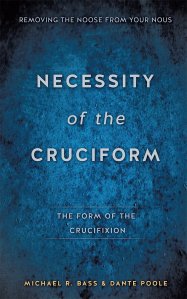
Release of ‘Necessity of the Cruciform’

The human condition is riddled with delusions about what is necessary for healthy spiritual life. We long for order and control, so we gravitate towards belief practices that have resulted in no more than a set of rules that we present as leading to God, but really always lead back to ourselves. They remind us of our condition and, when viewed rightly, glorify our need for the Grace of God. The mission of Christ has gotten lost in our desire to control sin by regulating people. It has suffered at the intentions of human beings to convert others to a way of life that is contrary to the intent of God. Until the church recognizes its bankrupt codes of corruption – its perverted religious attributes – it will not realize the Necessity of the Cruciform.
~ Taken from Necessity of the Cruciform by Mike Bass and Dante Poole © 2013

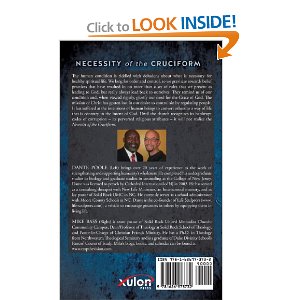
Necessity of the Cruciform     Back Cover

The book includes chapters on Religion, Another Gospel, The Logic of Faith, The Cruciform, and more. At the end of each chapter are tools for thinking about your thought processes – Removing the Noose from Your Nous; aids in loosening the strangleholds of the mind.

Necessity of the Cruciform is available anywhere books are sold and can be found on Amazon, BN.com, and iBook in electronic and paperback versions. Mike and Dante will have signed copies available soon, so catch them in person!

Dante and MikeDante Poole (Left) brings over 20 years of experience to the work of strengthening and supporting humanity’s wholeness. He completed his undergraduate studies in biology and graduate studies in counseling at the College of New Jersey. Dante was licensed to preach by Cathedral International of NJ in 2003. He has served as a consulting therapist with New Life Ministries, an International ministry, and as lay pastor of Solid Rock UMC in NC. He currently serves as a school administrator with Moore County Schools in NC. Dante is the co-founder of Life Sculptors (www.life-sculptors.com), a vehicle to encourage greatness in others by equipping them in living life.

Mike Bass (Right) is team pastor of Solid Rock United Methodist Church: Community Campus, Dean/Professor of Theology at Solid Rock School of Theology, and Pastor-In-Charge of Christian Friends Ministry. He has a Ph.D. in Theology (with a concentration in Pauline Theology) from Northwestern Theological Seminary and is a graduate of Duke Divinity School’s Pastors’ Course of Study. He is also the author of Gospel of Grace and The Pauline Corpus. Mike’s blogs, books, and calendar can be found at http://www.reapthevision.com.

Mystical Organic Union

I am, for the most part, a categorical thinker. Objects of which I think must fit categories set in my mind so that I can better understand them. The ancient categories of Who, What, When, Where, Why, and How (dating back to at least the first century B.C.) are extremely important to me in the process of understanding because they help to sift through mountains of evidence (and other “stuff” not concluded as evidence) to determine the facts of the matter, logically speaking. One object I have sought to understand, concerning the church, is “Why do ‘Christians’ return to the Mosaic Law after becoming a part of Christ (by definition)?”

Recently, as I’ve continued to work through the “5 W’s and an H” formula on my mission to figure out “Why” the church insists on returning to Law, it suddenly occurred to me that the church doesn’t appear to know (or understand) the “5 W’s and an H” of God’s worldview. The church understands the “Who” – Jesus. It understands the “What” – the Cross of Christ. It determines the “When” to be historical – approx. 2,000 years ago. Thus, the “Where” is historical Palestine. The “Why” is reconciliation with God, and the “How” is declared to be, ironically, the return to the Mosaic Law (beginning the process again because it is inconclusive).


I agree, the “Who” and “What” – Jesus and the Cross of Christ – are the focal points of God’s worldview. However, the “When” spans all space and time, and is not simply an historical point in time. Likewise, “Where” is everywhere; at all times, at the same time. If the church is correct in “Why” – reconciliation – then “How” we are reconciled has nothing to do with Law of Moses, and everything to do with the grace of God. The death of Christ has made us right with God, but we still can’t be in communion with Him because he is something OTHER (by definition) than us! Recognizing the still present separation, we return to the Law hoping it will bring us into God’s presence (though it never did in Israel). When we leave the Resurrection of Christ in the misty recesses of time, we leave the Resurrection Life of Christ there, too. We annually recall the event, but we do not daily live it. We acknowledge the Spirit of God, but deny His power.


The Apostle Paul explains to the Romans the “How” as a mystical, organic union between humanity and the dead Christ (the three days in the grave), which leads to the resurrection of Christ and the Resurrection Life of Christ in humanity. He says, “If we WERE united in death, then we ARE united in resurrection” [emphasis mine].The word “united” here is sumphutos – a growing together; an organic union where we mystically (spiritually) become one grouping of matter (Rom. 6:8-11; see also Phil. 3:10-11; 2 Tim. 2:11-13). When Christ died, in the misty recesses of time, believing humanity of all time died with Him, and we were buried with Him. The Greek speaks of the idea that we underwent the chemical breakdown of death and, at the resurrection event (three days later) our individual particles of matter were all drawn together into one collective/corporate whole – the Body of Christ. When Paul speaks of “the Body of Christ,” he means it not as a rhetorical figure of speech, but as a (mystical/spiritual) reality.


The “Why” of my inquiry is answered by the confusion over “When, “Where” and “How”? God’s worldview cannot be that Jesus has returned us to the Law, continuing the cycle throughout time; for the Law leads back to the “Who” – Jesus. We are the church precisely because the Resurrection Life of Christ empowers and equips us to live in and out of God’s worldview. We were reconciled to God through the death of Christ. We were incorporated into His death, mystically and organically becoming an actual (metaphysical) part of Him at His resurrection. As His resurrected Body we are restored into right relations with God, returning us (as it were) to the Garden, and walking with God in the cool of the day.